
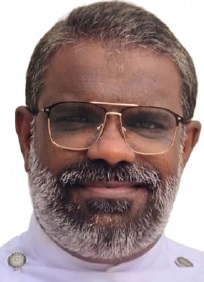
Rev. Dr. Joseph Samuel
Vicar
Greetings to you all in the gracious name of our Lord and Savior Jesus Christ.
We have entered into the second half of this year with hearts filled with gratitude
and hope. Gratitude for God and all other circumstances that have sustained us thus
far and hope that will move us forward with greater expectations and excitement.
The themes and readings related to the liturgical observances of this month are very significant for our faith and spiritual conduct. Christian stewardship, theological education, ordained ministry and marriage are the main subjects that regulate our worship gatherings on Sundays. Themes suggested by the Church through the liturgy are not simply meditative points or mere titles, rather they are, in essence, touch upon the core of our faith in Christ and our Christian behavior both in private and public. Biblical and theological understandings of Christian stewardship invite us to a sense of faithfulness and trustworthiness in terms of what are given to us as the blessings of God. It is more than management, the idea of giving and imparting the essence of God defines the basic pretext of stewardship. Stewardship is not managing what we have without losing but gaining, it is spiritual process of losing it to gain absolute goodness. It is about sharing the blessings of God without storing it up for oneself or for a few minorities. Stewardship is being sensitive and responding to the least ones of God in terms of our willingness to permit the disadvantaged ones to participate with us. Theological education is generally misunderstood as the seminary education that prepare few individuals for the various ministries of the Church. But theological education is meant for the entire community of God where we together learn and transform for the purpose of the Kingdom of God. It is the entire community engaged in the process of changing ourselves in the knowledge of both Word and world to transform the universe as the household of God and the creations are the partners in this household.
Medieval theologian St. Anslem defines theology as “Faith Seeking Understanding.” When we try to
understand ordained ministry, specifically the theological understanding of priesthood of the Church, we are confused due to the diverse definitions from different traditions. Ordination is a public act of selecting and destining few among all to carry out specific responsibilities for the common good of the community. Ordained ministry can’t exclusively be understood as priestly ministry, any responsibility that pertains to the growth and unity of the faith community or any community can be seen as ordained ministry, and it is the specific purpose that makes the ministry as ordained. Marriage is another subject that we study this month. We consider marriage as multilateral covenant, where God, the wedded, family and society etc. are engaged in a mutual relationship based on love, respect and dignity. In marriage, quite often we give importance to the ceremonial and festive part largely ignoring the spiritual and social aspects. Marriage is a beginning where the involved started to find each other in love thereby they encounter and experience God, for God is better experienced in true love and sacrificial self-giving.
As the church moves on, we need to move with her in constantly participating in the worship and mission life of the community. We need to constantly get-together in the name of Christ, united in Spirit to be a Church of God.
Wishing a blessed month,
With prayers,
Rev. Dr. Joseph Samuel
Vicar, Seaford